

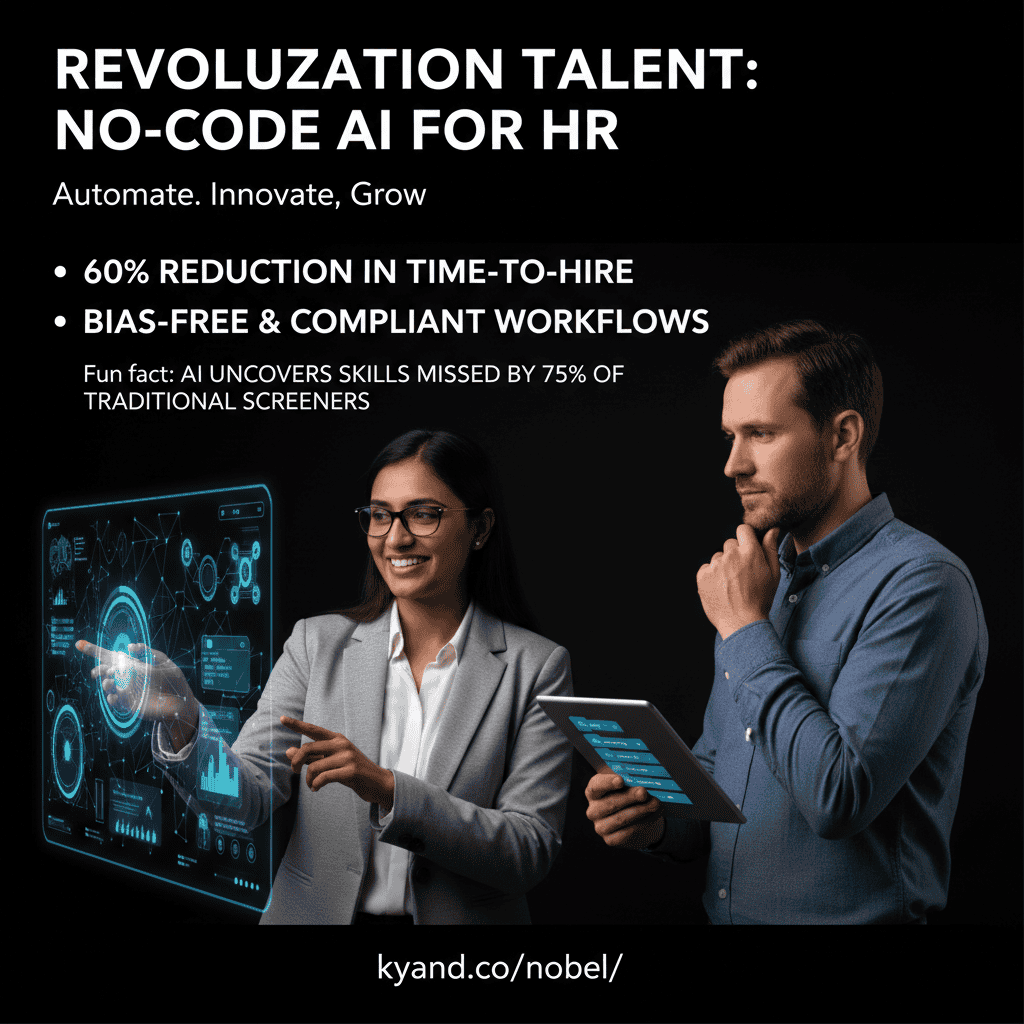
Revolutionizing Talent Acquisition: No-Code AI Workflows for HR in Tech Startups
Estimated reading time: 6 minutes
- Embrace No-Code Solutions: Consider adopting platforms to streamline your workflows and reduce the time-to-hire without extensive technical resources.
- Implement AI Responsibly: Leverage AI technology to enhance your hiring processes but maintain human oversight, ensuring that your recruitment mechanisms are fair and equitable.
- Focus on Skills Matching: Use platforms that prioritize skills matching to help identify fit on both technical and cultural levels, which is essential for tech startups.
- Monitor Compliance: Be vigilant about the data privacy standards and compliance measures of any AI platforms you choose to adopt. In today’s regulatory landscape, compliance is crucial.
Table of Contents
- Overview of AI-Powered Talent Acquisition Transformation
- No-Code AI Workflow Solutions
- Automating Core Recruitment Functions
- Achieving Significant Time Reduction
- Compliance and Bias Mitigation
- Startup-Specific Implementations
- Advanced AI Capabilities
- Industry Context
- Practical Takeaways for Recruiters and HR Professionals
- Conclusion
- Call to Action
- FAQ
Overview of AI-Powered Talent Acquisition Transformation
The traditional recruitment model is rapidly becoming obsolete as technology continues to redefine HR practices. According to recent findings, modern no-code AI workflows are crucial in enabling tech startups to streamline their recruitment processes dramatically. These platforms reduce complexity, eliminate the necessity of extensive technical expertise, and significantly shorten implementation timelines – allowing startups to hire effectively. For more insights, refer to HR Technology Conference and TalentHR.
Gone are the days when HR teams had to juggle multiple disconnected tools, often leading to inefficiencies. These no-code solutions unify recruitment platforms under a cohesive structure, optimizing every step of the hiring journey while maintaining compliance and mitigating bias.
No-Code AI Workflow Solutions
Unified Recruitment Platforms
One exemplary player in this space is Candid, a no-code AI platform that merges various recruitment tools into one streamlined system. By utilizing a unified recruitment platform, startups can execute their hiring strategies without the hinderance of managing multiple software, thereby enhancing both efficiency and effectiveness (HR Technology Conference).
Rapid Implementation and Setup
Quick deployment is a hallmark of modern HR platforms, exemplified by CLO.ai, which can be operational within as little as 24 hours. This rapid setup allows startups to dive into automating crucial recruitment functions immediately—a critical advantage in competitive markets. Similarly, TalentHR offers a comprehensive HR solution that can be initialized with just a few clicks, embedding AI features seamlessly into the workflow (Cielo Talent, TalentHR).
Automating Core Recruitment Functions
Resume Processing and Candidate Screening
Automating candidate evaluation is where no-code AI truly shines. RChilli‘s AI agent capabilities autonomously enhance recruitment workflows by extracting, enriching, redacting, and analyzing candidate data. This technology improves data quality and increases efficiency by summarizing CVs, scoring candidate suitability, and flagging top applicants automatically (HR Technology Conference, TalentHR).
Interview Scheduling and Management
AI platforms not only optimize screening but also enhance interview logistics. Autonomous AI agents can conduct initial interviews and identify standout candidates, allowing hiring teams to focus on strategic aspects of recruitment rather than administrative details. AltHire AI’s TalentBoost platform exemplifies this by reducing time-to-hire by 60% through automated screening interviews and processes (Eightfold AI, HR Technology Conference).
Skills Matching and Candidate Ranking
Next-gen AI platforms like PageUp provide robust skills-matching capabilities, dynamically extracting skills without a predefined taxonomy. This flexibility enables HR teams to discover talent more efficiently and fairly, while NeuroScale AI’s Arba platform employs transparent, auditable analysis to generate ranked shortlists from vast applicant databases (HR Technology Conference).
Achieving Significant Time Reduction
For startups, the opportunity to decrease hiring time dramatically cannot be overstated. Platforms leveraging AI for recruitment are witnessing reductions in hiring timelines. AltHire AI stands out with a reported 60% decrease in time-to-hire, allowing recruitment teams to redirect their energies towards building relationships and assessing cultural fit (HR Technology Conference).
Compliance and Bias Mitigation
Data Handling and Privacy
With great power comes great responsibility, particularly regarding candidate data. Modern AI platforms ensure compliance with regulations through embedded data privacy protections. For instance, TalentHR is engineered to manage sensitive information securely, while CLO.ai incorporates built-in parameters designed collaboratively with compliance and diversity teams to promote inclusivity (TalentHR, Cielo Talent).
Reducing Algorithmic Bias
Counteracting algorithmic bias is a guiding principle for many innovative HR platforms. Solutions like NeuroScale AI offer transparent candidate analysis, which not only streamlines the hiring process but also ensures equity in candidate evaluation. By automating data processing and analysis, platforms like RChilli promote a more inclusive hiring environment, crucial for today’s diverse talent pools (HR Technology Conference, Cielo Talent).
Startup-Specific Implementations
Scaling Recommendations by Growth Stage
The needs of a startup shift significantly through various growth stages. Seed-stage companies typically benefit from lightweight Human Resource Information Systems (HRIS) focusing on centralized employee data and onboarding. As firms mature and scale (like Series A startups), more complex structures, including applicant tracking systems (ATS) and employee engagement tools, become essential (TalentHR).
Human-in-the-Loop Approach
Despite advances in AI, engaging human intelligence remains irreplaceable in key hiring decisions. The best practices emphasize a human-in-the-loop framework where AI tools assist but do not supplant the vital judgment of HR professionals. This strategy helps to maintain fairness and accountability across hiring practices, reducing risks associated with over-reliance on automated systems (TalentHR).
Advanced AI Capabilities
Generative AI Integration
Among the most sophisticated features of AI recruitment platforms is the use of multiple foundational models. For example, CLO.ai employs a diverse array of models, ensuring flexibility and adaptability to cater to varied client needs (Cielo Talent).
Autonomous Agents and Task Automation
Platforms such as Eightfold AI operate autonomous agents that handle repetitive tasks, thereby empowering HR professionals to concentrate on nurturing talent relationships. These systems leverage data from disparate sources, presenting recruiters with real-time insights and automations directly relevant to their workflows (Eightfold AI).
AI-Driven Insights and Analytics
Analytics is vital for strategizing within the recruitment landscape. AI-driven insights enable HR teams to make data-backed decisions. Solutions like PageUp’s Paige AI provide smart guidance and task automation, enhancing the overall hiring experience (HR Technology Conference).
Industry Context
The HR technology sector is ripe with innovation as new startups and established vendors alike introduce AI-powered solutions aimed directly at the recruitment workflow. This vibrant ecosystem is responsive to competitive pressures, yielding continuous advancements in speed, accuracy, and usability. The shift towards no-code interfaces, generative AI, and specialized workflows is enabling HR to function at an enterprise level, critical for startups competing for technical talent in crowded markets (HR Technology Conference, Y Combinator).
Practical Takeaways for Recruiters and HR Professionals
- Embrace No-Code Solutions: Consider adopting platforms like Candid and CLO.ai to streamline your workflows and reduce the time-to-hire without extensive technical resources.
- Implement AI Responsibly: Leverage AI technology to enhance your hiring processes but maintain human oversight, ensuring that your recruitment mechanisms are fair and equitable.
- Focus on Skills Matching: Use platforms that prioritize skills matching to help identify fit on both technical and cultural levels, which is essential for tech startups.
- Monitor Compliance: Be vigilant about the data privacy standards and compliance measures of any AI platforms you choose to adopt. In today’s regulatory landscape, compliance is crucial.
Conclusion
The incorporation of no-code AI workflows is a game-changer for tech startups aiming to revolutionize their talent acquisition processes. By automating core functions, preserving compliance standards, and reducing hiring timelines, startups can focus on strategic growth and building agile teams. At KY & Company, we specialize in digital transformation consulting and SaaS solutions designed to meet the unique challenges of your business. Explore our services to discover how we can help you leverage AI automation effectively for your hiring needs and stay competitive in this fast-evolving landscape.
Call to Action
Ready to transform your talent acquisition strategies? Contact Us today to learn more about how KY & Company can help you integrate no-code AI workflows into your HR practices and lead your tech startup to new heights!
FAQ
What are no-code AI workflows?
No-code AI workflows are automated recruitment processes that require no programming skills to implement, enabling HR teams to streamline hiring without extensive technical knowledge.
How do AI tools help in hiring?
AI tools help in hiring by automating candidate screening, enhancing resume processing, managing interview logistics, and ensuring compliance, which collectively streamline the recruitment process.
Can startups benefit from AI in recruitment?
Yes, startups can significantly benefit from AI in recruitment by reducing time-to-hire, improving candidate quality, and automating administrative tasks, allowing HR teams to focus on strategic initiatives.
What are the compliance implications of AI in HR?
Compliance implications include ensuring data privacy, managing sensitive candidate information securely, and promoting equitable evaluation processes to avoid algorithmic bias.
How important is human oversight in AI-driven recruitment?
Human oversight is critical in AI-driven recruitment to ensure fairness, accountability, and to mitigate risks associated with over-reliance on automated systems.


